
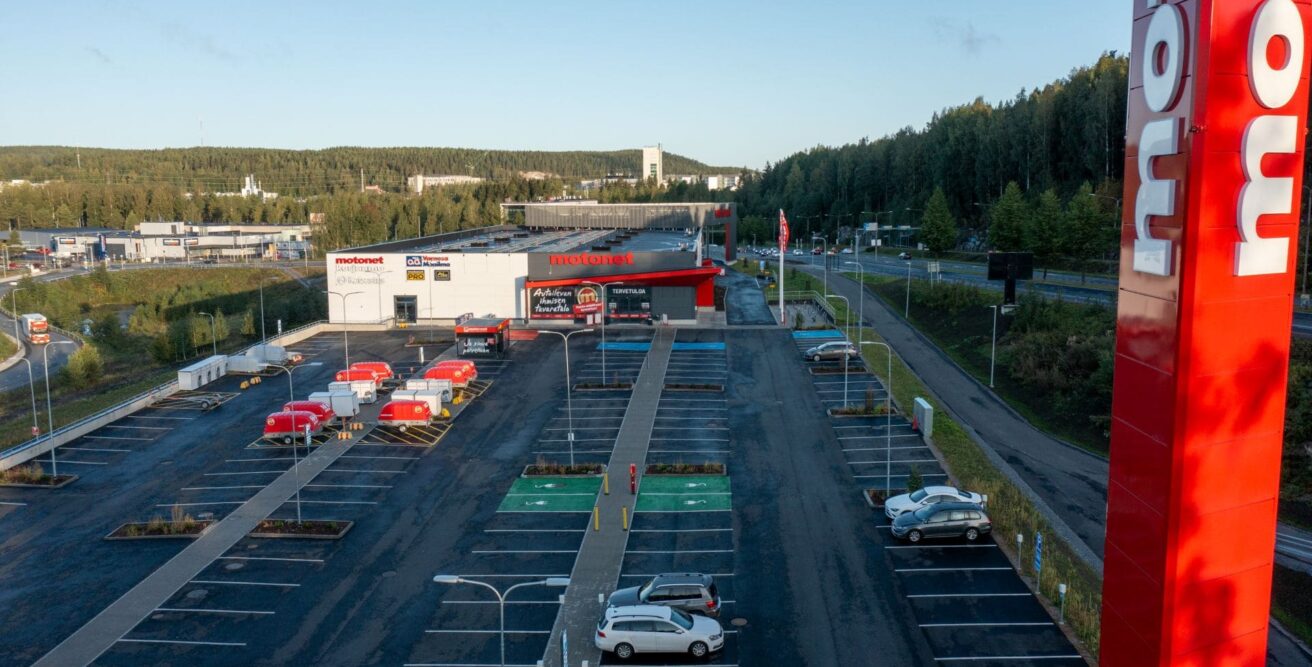
At Motonet stores, air filters were previously replaced according to a traditional schedule—twice a year. Vado, however, assessed the condition of the air filters at the Kuopio store and conducted a six-month pilot project at the facility. Based on this pilot, the expert firm Granlund prepared an energy analysis, which indicates that Motonet could achieve total annual savings of up to 40,000 euros by using Vado’s filters.
Seeking more energy-efficient filters
Leevi Mäkinen, Real Estate Manager at Broman Yhtiöt—the company that manages the properties of the Motonet retail chain—first learned about the potential of Vado’s filters when Tommi Moilanen, a sales specialist at Vado, reached out to him.
“We had been looking for better energy efficiency from our air filters and had already discussed potential options with our previous filter supplier. As it happens, Tommi called at just the right time, so we were able to include Vado in the competitive bidding process,” says Mäkinen, adding:
The Kuopio site had a total of seven air handling units, six of which were included in the pilot project. These units handle ventilation and heat recovery for various types of spaces, including the retail area, the workshop, and the offices.
Based on an assessment conducted by Vado, the air handling units are now equipped with the optimal types of filters.
“The results of the pilot were so promising that we decided to enter into agreements with Vado for all our other properties as well,” says Mäkinen.
Proven results with Granlund’s energy calculations
To demonstrate the efficiency of its filters, Vado provided an energy calculation as part of the pilot project; this calculation was carried out independently by Granlund Oy, an expert firm in the real estate and construction sector.
The calculation utilized both data from the pilot period and historical data from the building automation system.
“Typically, filters are replaced twice a year. The study also explored whether it would be possible to extend the replacement interval using the current [Vado] filters,” explains Tuomas Hietala, Business Development Manager at Granlund Oy.
Total savings potential of at least 40,000 euros without compromising indoor air quality
Based on a six-month monitoring period at the Kuopio store and energy calculations performed by Granlund, the total estimated annual savings potential for all Motonet department stores is at least 40,000 euros. The largest cost reduction comes from energy savings, with an estimated total potential of €30,000 per year across all locations.
The next largest source of savings is expected to be waste-related costs; the use of Vado filters is projected to yield savings of €7,000 per year. Finally, savings of approximately €4,300 per year are expected across all stores regarding replacement costs, as the maintenance team will spend less time performing filter changes.
“A surprising finding was that, with the previous supplier’s filters, the pressure differential would begin to rise after just a few months of use—reaching a level where the filters were effectively due for replacement. In contrast, with Vado filters, the pressure differential remained comparable to that of a brand-new filter for a very long time,” explains Leevi Mäkinen.
Tuomas Hietala from Granlund also confirms the differences compared to the older type of filters:
“Our study showed that this type of [Vado] filter does not become clogged nearly as quickly as traditional filters. This is because the new filters feature a larger surface area through which air can pass.” Thanks to the filter’s design, the pressure differential does not increase, Hietala notes, adding:
“As long as the filtration efficiency remains good, there is no reason to replace the filters unnecessarily.”
Hietala also mentions that when switching to a new type of filter, there is often a concern that indoor air quality might deteriorate. However, this risk can be kept under control by monitoring the pressure differential across the filters and the quality of the indoor air. Naturally, this applies to all types of filters.
Smaller environmental impacts
In addition to the energy savings achieved at Motonet stores, Vado filters offer other environmental benefits.
“This particular [Vado] filter can be disposed of as energy waste. In contrast, filters often contain materials that require temperatures of up to 600 degrees Celsius to be incinerated,” Hietala explains.
In other words, Vado filters also save energy during the waste incineration process.
Furthermore, the replacement interval for Vado filters has doubled, which means the volume of waste generated from used filters—all of which can be disposed of as standard energy waste—has been cut in half.
“Just consider the total number of filters used in Finland every year; it’s a significant amount. Personally, I see this reduction in waste volume as a major achievement,” Hietala concludes.
Active communication and cooperation receive praise
However, the benefits provided by Vado’s filters do not stem solely from the products themselves. The overall value is derived from Vado’s service model, which encompasses site assessments, precise filter sizing, and optimization tailored to individual pieces of equipment.
The partnership between Motonet and Vado—which spans all their department stores—has been in place for only a few months, yet Leevi Mäkinen is pleased with the results so far.
“The collaboration has gotten off to a great start. We requested a single, dedicated point of contact, and that is exactly what we’ve received. Tommi has consistently kept us well-informed about the progress. I can certainly recommend working with them,” says Mäkinen, adding:
“While I would say the primary reason we chose Vado was the energy efficiency and operational reliability of the filters—as demonstrated by a pilot project and calculations performed by Granlund—another significant factor was Tommi’s personal approach: he visits the sites himself to conduct assessments and keeps the client thoroughly updated. That played a major role in our decision.